Italy is the country where "do I need a travel adapter?" has three answers depending on the age of the building you're staying in. There's the Italian-specific Type L plug, the pan-European Type C Europlug, and the increasingly common German Type F Schuko. None of them fit a US plug. Most of them don't fit each other.
Here's what to pack:
- From the US or Canada: Adapter required. Voltage check required.
- From the UK: Adapter required. Voltage match is fine.
- From the EU (Schengen): Often nothing needed, but check, your Europlug might not fit older Type L sockets.
- From Australia or NZ: Adapter required. Voltage match is fine.
What plug does Italy use?
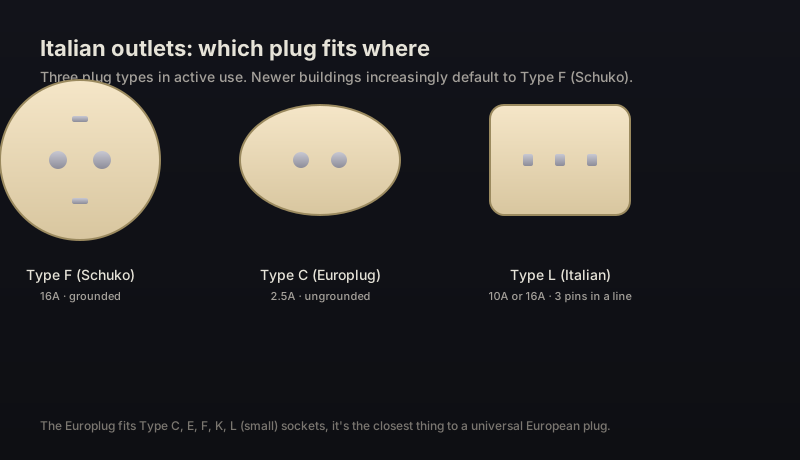
Italy is one of the few European countries with a homegrown plug standard, Type L. It's three round pins in a straight line and was designed in the 1960s to replace a chaotic mix of pre-war regional standards. You'll meet it in two sizes:
- Type L 10 A, thin pins, 4 mm spacing. Used for household electronics, lamps, computers.
- Type L 16 A, thicker pins, 8 mm spacing. Used for higher-draw appliances like washing machines, ovens, and air conditioners.
Then there's Type C, the Europlug, with two thin round pins. Most Italian sockets accept it, because the Europlug was deliberately designed to fit Type C, E, F, K, and small Type L outlets.
And increasingly in newer Italian buildings, Type F, the German Schuko plug with two round pins and side ground clips. Italian construction since the 2000s often installs hybrid sockets that accept both Type L and Type F, the same way many German modern outlets accept Europlugs.
What this means in practice: bring an adapter that handles all three plug types, or assume Type L and verify when you arrive.
Italy's voltage and frequency
Italy runs at 230 V, 50 Hz, same as the rest of harmonized Europe. If you're coming from the UK, France, Germany, Spain, or anywhere in the EU, your devices already match the voltage and frequency, only the plug shape changes.
If you're flying in from the US (120 V) or Canada (120 V), the voltage doubles. Modern dual-voltage chargers (look for "100-240 V" on the brick) handle this without issue. Single-voltage US appliances will burn out, see our voltage explainer for the full breakdown.
Do I need a travel adapter for Italy? By origin country
From the United States or Canada
Yes, and check your voltage too. Buy a US-to-Italy adapter that handles both Type L and Type F (most "Europe" adapters do). Check every device for "100-240 V" before you pack. Hair dryers, curling irons, straighteners, and battery chargers labeled "120 V" only will not work, either swap them or buy in Italy.
From the United Kingdom or Ireland
Yes, but you don't need a voltage converter. UK 230 V matches Italian 230 V, so everything you pack just works once you have the plug shape right. Any UK-to-Europe adapter does the job. The cheap airport ones are fine for Type L if they explicitly say so, some old "UK to Europe" adapters only fit Type C/F and miss Type L 16 A sockets.
From the EU (Schengen area)
Often nothing, but verify. If your home plug is a Europlug (Type C), it fits Italian Type C and most Type L 10 A sockets directly. If your home plug is a Schuko (Type F), it fits Italian hybrid sockets but not older pure Type L 10 A or 16 A sockets common in older buildings, especially outside major cities.
If you're staying in a B&B, a restored country house, or any building from the 1960s through 1980s, pack a small adapter that converts Schuko to Type L 10 A. They cost €3 at any Italian supermarket if you forget.
From Australia or New Zealand
Yes, and you're lucky on the voltage front. Australian Type I plugs are physically incompatible with anything in Italy, but Australian 230 V matches Italian 230 V exactly. Any Type I to Europe adapter works. Look for one that includes Type L coverage explicitly.
Choosing single-country vs universal
For a one-week Italian holiday, a single-country adapter is the right buy:
- $4-8 single-country Europe adapter at any travel store
- Covers Type C, F, and L on one body
- Pocket-sized; nothing to break
For a multi-country European trip (Italy + UK + Switzerland is a common combo), pay up for a universal adapter. The UK uses Type G, Switzerland uses Type J (its own variant), and the Type L situation makes Italy weird enough that a universal with explicit Italian support saves time.
What to look for in a universal:
- Explicit Type L support, not all universals cover it. Some "universal" adapters skip Italy entirely.
- USB-C PD port at 30 W or higher for laptops
- Surge protection for older Italian wiring (especially anywhere in southern Italy where summer storms cause spikes)
- A retractable Type L pin set, not a fold-out one
The one mistake that fries devices
Plugging a US-only 120 V appliance into an Italian outlet via a passive adapter doubles the voltage and the device will fail, sometimes spectacularly. This is the most common "I broke my hair dryer in Italy" story and it always comes from skipping the "100-240 V" check on the device label.
Adapters change the plug shape. They do not change the voltage. The device itself either accepts both 120 V and 230 V (it'll say so on the brick), or it doesn't (treat it like it won't survive).
Practical answers for common Italian travel situations
Will my MacBook charger work in Italy? Yes, every Apple charger is dual voltage. Add a Type L adapter and you're set.
My Airbnb host says the outlets are Type F. Is my Europlug okay? Yes, Europlugs fit Type F sockets fine. They just don't fit Type L 16 A.
I have a Schuko (Type F) hair dryer from Germany. Will it work in Italy? Plug-fit is iffy on older Italian Type L outlets but works in newer hybrid sockets. The voltage matches at 230 V. Worst case, buy a €3 Schuko-to-L adapter at a Carrefour Express.
Do Italian hotels provide adapters? Most 3-star and up do at reception, but supply is limited. Bring your own.
Is the Vatican on Italian electrical standards? Yes. The Vatican has the same 230 V mains and uses the same Type L / Type F socket mix. Your Italian adapter works there.
What about Sicily and Sardinia? Same standards as the mainland. Italian Type L plus increasing Schuko presence. No surprises.
Charging multiple devices at once
A single Italian outlet is either ungrounded (Type C) or grounded (Type F/L), and Italian sockets are often spaced far apart in old buildings, a power strip is unusually useful here. Three approaches:
- A GaN multi-port charger with a Europlug (Type C), fits most Italian outlets directly, charges 4 devices off one socket
- A travel power strip with Type C input and 3 grounded universal sockets, handy if you're a couple sharing a hotel room with one outlet
- A USB-C hub adapter, plugs into the wall, exposes 4 USB-C ports
The Italian Type L 16 A socket is what powers most B&B kitchen appliances and tends to be located in awkward places (behind a fridge, under a counter). Don't count on it for charging.
The bottom line
Italy needs a travel adapter for every traveler who isn't already on a Europlug-or-Schuko home setup. The cost is €3-8 if you buy in country, $5-15 if you buy at home, and zero if your accommodation provides one, which most do.
Voltage-wise, the only travelers who need to worry are coming from the US, Canada, Japan, or any other 100-120 V country. The dual-voltage label on your charger is the line between "works fine" and "permanent damage."
Pack the adapter. Check the voltage. Enjoy the gelato.