If you're flying to Japan in 2026 and you've spent ten minutes Googling whether you need a travel adapter, you've probably noticed the answer keeps depending on something. Here's the short version, before the detail:
- Coming from the US or Canada? You almost certainly don't need an adapter. Your plugs already fit.
- Coming from the UK, EU, Australia, NZ, or anywhere else? Yes, you need a cheap Type A adapter, and you might need a voltage converter for a couple of specific appliances.
That's it. The rest of this guide is the why, the edge cases, and how to avoid the one mistake that fries devices.
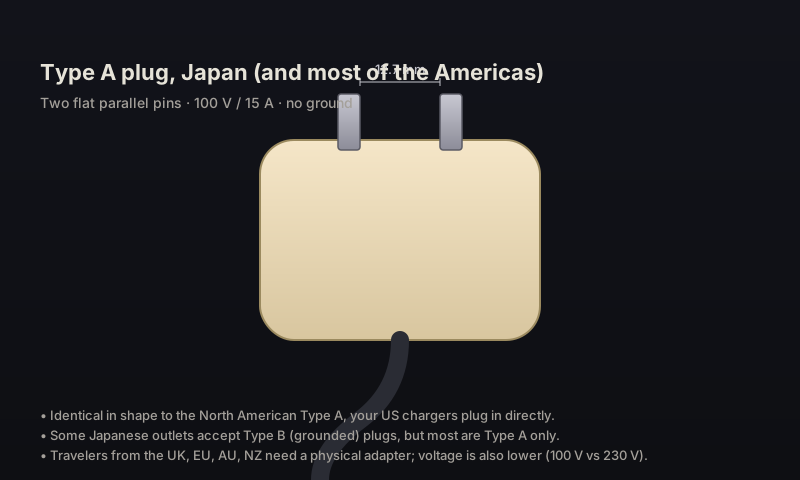
What plug does Japan use?
Japan uses the Type A plug, two flat parallel pins, no ground. It's the same shape as the standard North American plug, which is why US and Canadian travelers can skip the adapter store entirely.
A small minority of newer Japanese sockets accept Type B (the grounded three-prong version of Type A), but you can't count on it. Hotels built in the last 20 years are more likely to have Type B; older ryokan and apartment-style accommodations almost always have ungrounded Type A only.
If you're bringing a US three-prong appliance and your hotel only has Type A sockets, a $3 three-to-two-prong "cheater" adapter handles it.
Japan's voltage is the real curveball
This is the part most guides bury. Japan runs at 100 volts, lower than every other major travel origin on Earth.
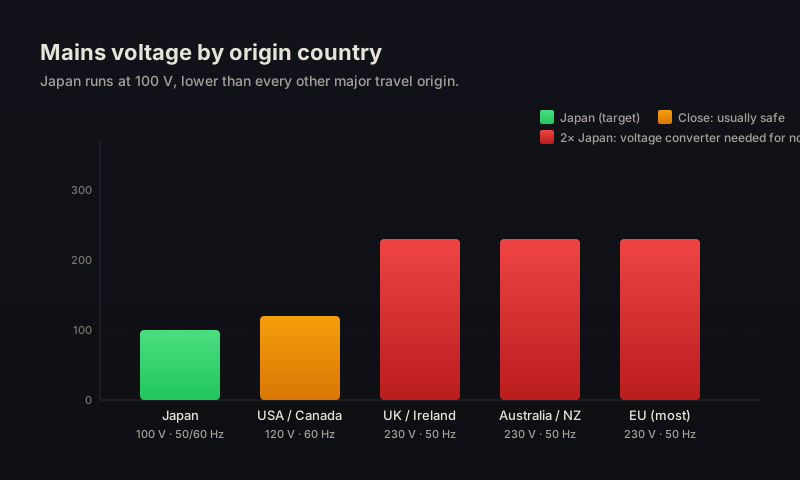
For 95% of what you're bringing, phones, laptops, tablets, cameras, headphones, e-readers, electric toothbrushes, none of this matters. Look at the small print on your charger. If it says "100-240V" anywhere, you're fine. That charger will quietly do the voltage conversion for you. This is true of essentially every Apple charger made in the last decade, almost every USB-C wall brick, and most laptop power supplies.
The 5% that bites people:
- Hair dryers rated 220-240V only
- Curling irons and straighteners rated 220-240V only
- Electric shavers that are single-voltage (rare on modern Braun/Philips, common on cheap ones)
- Kettles, irons, anything with a heating element designed for European or Australian mains
These devices will underperform at 100V (heating elements need their rated voltage to reach temperature) or, in the case of devices with motors and electronics, fail outright. To use them in Japan you'd need a step-up voltage converter, and honestly, for hair dryers and shavers, it's cheaper to buy a Japan-rated one when you arrive or just use the hotel's.
How to check if your charger is dual voltage
Flip the charger over. Look for a line that reads something like:
INPUT: 100-240V ~ 50/60Hz 0.5A
If both the bottom voltage (100V or below) and the top voltage (240V or above) are listed, you're fully covered. If it says only "120V" or only "230V", that device needs a converter, not just an adapter.
What about the 50/60 Hz split in Japan?
Japan is the only country in the world with a split electrical grid. Eastern Japan (Tokyo, Sendai, the Tohoku region) runs at 50 Hz. Western Japan (Osaka, Kyoto, Hiroshima, Fukuoka) runs at 60 Hz. The dividing line runs roughly through Shizuoka prefecture.
The split is a 130-year-old accident: in the 1890s, Tokyo Electric bought generators from AEG in Germany (50 Hz) and Osaka Electric bought from General Electric in the US (60 Hz). Each city built out its grid on its own standard, and Japan never unified them. For more background, see our history of plugs post.
For modern electronics with switching power supplies, the frequency difference is invisible. Where it shows up:
- Old analog clocks and timers designed for one frequency may run slow or fast
- Motor-driven appliances like vintage record players and some kitchen gear can drift
- Inductive cooktops and certain rice cookers sold in one region of Japan may not perform optimally in the other
As a traveler, you'll never notice the split. Even Japanese consumer electronics are built to handle both frequencies for exactly this reason.
Do I need a travel adapter for Japan? By origin country
From the United States or Canada
No adapter needed for two-prong devices. Your Type A plugs go straight into Japanese sockets. For three-prong (grounded) Type B devices, bring a small grounded-to-ungrounded adapter or rely on your hotel having modern outlets.
Voltage-wise: Japan's 100V is slightly below the US's 120V. Modern dual-voltage chargers don't care. Single-voltage US devices (rare today) will run slightly underpowered but won't be damaged.
From the United Kingdom or Ireland
Yes, you need a UK-to-Type-A adapter. Your three-prong Type G plug physically cannot enter a Japanese socket. Any single-country UK→Japan adapter works; expect to pay $5-10 on Amazon or about £8 at a UK airport.
Voltage matters more here: UK mains is 230V, more than twice Japan's 100V. Check every device. Phone chargers, laptop bricks, and camera chargers will almost always be dual voltage. UK hair dryers, straighteners, and shavers are usually 230V-only, leave them at home.
From the EU (Germany, France, Spain, Italy, Netherlands, etc.)
Yes, you need a Europlug-to-Type-A adapter. The Europlug's two round pins won't fit Japan's flat slots. EU-to-Japan adapters are widely sold; the cheap ones work fine since Type A only needs to make basic contact.
Same 230V → 100V voltage warning as the UK: dual-voltage electronics fine, single-voltage heating appliances don't.
From Australia or New Zealand
Yes, you need a Type-I-to-Type-A adapter. Your angled-pin plug won't go in. The voltage drop is the same as UK/EU (230V to 100V), so the same dual-voltage check applies.
A useful side benefit if you're an AU/NZ traveler: a Type I-to-Type A adapter is one of the few that's hard to find at airports outside Australasia, so buy before you fly.
From everywhere else
If you're starting from somewhere that uses any plug other than Type A or B (most of the world), you need a Type A adapter. The voltage check is the same regardless: if it says "100-240V" on the brick, you're fine; if it doesn't, leave it home or buy local.
Choosing a Japan-specific adapter vs a universal one
If Japan is your only destination this trip, buy a single-country adapter. They're $5, fit in your laptop bag, and there's nothing to go wrong with a slab of plastic and four bits of metal.
If you're hitting multiple countries (Japan + Korea, or Japan + Australia + Singapore on the same trip), a universal travel adapter earns its keep. Look for:
- Built-in USB-C PD (Power Delivery) port rated at 30W or higher, handles laptops
- A retractable Type A insert, not a fold-out one (more durable, less to break)
- A surge indicator LED (cheap insurance against bad hotel wiring)
- Total wattage rating clearly printed on the body, at minimum 1000W
Avoid universal adapters without surge protection if you'll be using them in older accommodations. Voltage spikes are uncommon in Japan but not impossible, especially after typhoons.
The one mistake that fries devices
Almost every "I broke my laptop in Japan" story online has the same root cause: someone brought a 220-240V-only device, plugged it into a Type A socket via a passive adapter, and turned it on. The adapter just changes the plug shape, it does not change the voltage. A 230V hair dryer plugged into Japanese 100V will underperform but probably survive; a 100V-only Japanese appliance plugged into European 230V will burn out immediately, and a single-voltage Australian curling iron plugged into Japanese 100V via an adapter will simply not heat up.
The fix: read the back of every device before you pack it. If it doesn't say "100-240V", either don't bring it, or bring a step-up voltage converter (heavy, expensive, awkward, and rarely worth it for a trip).
Charging multiple devices at once
A single Japanese outlet is two-pin and ungrounded, so plugging in a strip can quickly look messy. A few options that don't involve unscrewing wall plates:
- A GaN multi-port USB-C/USB-A charger with a Type A plug, one wall socket, four devices. The Anker 735 and similar work in Japan natively without an adapter (because they have a Type A plug already).
- A travel power strip with Type A input and 2-3 grounded sockets on the output, useful if you're a couple sharing one outlet.
- A USB-C hub adapter that plugs into Japanese Type A and exposes 2-3 USB-C ports. Compact, no need for individual chargers per device.
If you're using our compatibility checker, you can plug in any device's voltage and amp rating to see what's safe with Japanese mains in seconds.
Practical answers for common situations
Will my MacBook charger work in Japan? Yes. All Apple chargers are dual voltage. Plug the US plug straight in, or use any Type A adapter if you have a UK/EU/AU MacBook.
Can I charge my iPhone in Japan with a UK cable? The cable doesn't matter, it's the wall brick that needs to be dual voltage. Apple's USB-C wall chargers are dual voltage worldwide.
Will my Dyson hair dryer work? Almost certainly not without a step-up converter. Dyson sells region-specific models for a reason, the UK/EU Supersonic is 230V only. The Japanese model exists and is also called the Supersonic but is internally different.
Do Japanese hotels provide adapters? Most do, but only at the front desk and in limited quantities, don't rely on it. The price of one airport coffee buys a permanent adapter you'll have forever.
Can I buy an adapter at Narita or Haneda airport? Yes, but at airport markup. ¥2,000-3,500 for the same adapter Amazon sells for ¥600. Buy before flying.
Will my electric razor explode if it's UK 230V? No, but it will charge ineffectively (or not at all) on Japanese 100V, and depending on the model it may damage the charging circuitry over time. Bring a battery-powered backup or use the included travel travel pouch trick: charge fully before you fly, hope it lasts the trip.
The bottom line
For 95% of travelers visiting Japan, the actual answer to "do I need a travel adapter for Japan?" is one of two things:
- From the US/Canada: No. Your plugs fit. Your chargers are dual voltage. You're done.
- From everywhere else: Yes, a $5 single-country Type A adapter and a quick check that your chargers say "100-240V".
If you take nothing else from this guide: the adapter changes the plug shape, the device needs to handle the voltage on its own. Adapters are cheap. Voltage converters are heavy. Devices labeled "100-240V" make both unnecessary.