Mexico is the easiest international destination for US and Canadian travelers when it comes to power: same plug shapes, near-same voltage, same frequency. You can fly in with your charger in your pocket and plug it straight into the wall. For everyone else (UK, EU, Australia, Asia), an adapter is needed and the voltage is half what you're used to.
Quick answer by origin:
- From the US or Canada: Nothing needed.
- From the UK: Adapter required. Voltage check required (some UK 230V devices won't run at 127V).
- From the EU (Schengen): Adapter required. Voltage check required.
- From Australia or NZ: Adapter required. Voltage check required.
What plug does Mexico use?
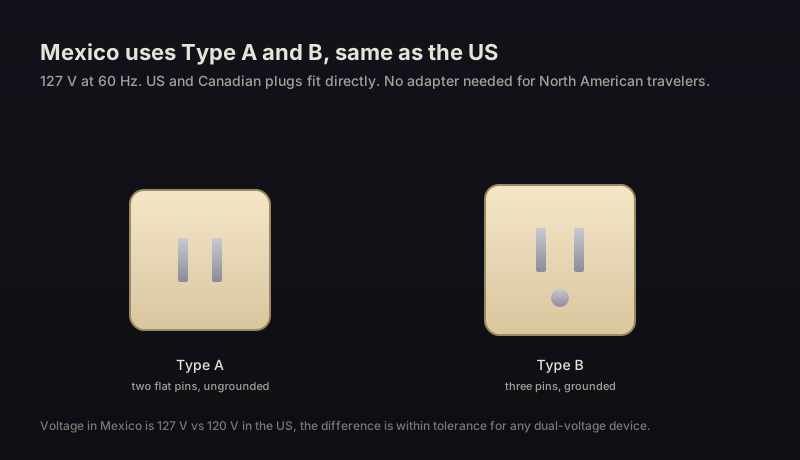
Mexico uses Type A and Type B plugs, the same shapes as the US and Canada. Type A is the two flat parallel pins, ungrounded. Type B adds a round earth pin below for three-prong appliances. Mexican sockets are virtually identical to North American sockets in dimensions and pin spacing.
In practice:
- Hotels and modern construction: Type B grounded sockets, often spaced widely apart on the wall
- Older buildings, small inns, beach palapas: Type A only (ungrounded), three-prong US devices need a cheater adapter
- Public charging stations and airports: Type B with USB-A and USB-C ports
Mexico's voltage and frequency
Mexico runs at 127 V, 60 Hz, operated by the CFE (Comisión Federal de Electricidad). The voltage spec is 127 V but real outlet voltage typically falls between 120 V and 130 V depending on time of day, region, and grid load. For any device rated 100-240 V or 110-127 V, this range is comfortable.
The frequency match with the US (60 Hz) means time-keeping appliances (clocks, vintage record players) run at the correct speed, unlike in Europe.
For US and Canadian travelers, voltage and frequency are functionally identical to home. You're not going to notice a difference.
For travelers from 230 V countries (UK, EU, Australia, most of Asia), the voltage is roughly half your home mains. Most modern dual-voltage chargers handle 127 V fine, but the voltage drop will cause issues for:
- Single-voltage 230 V hair dryers (won't reach operating temperature)
- Single-voltage 230 V curling irons and straighteners (same)
- Anything labeled 220-240 V only (will run dramatically slower or not at all)
Do I need a travel adapter for Mexico? By origin country
From the United States or Canada
Nothing needed. Your plugs fit. Your voltage matches close enough. Your chargers work as they do at home. The only edge case is if your accommodation has only Type A (ungrounded) sockets and you have a three-prong appliance, in which case a cheap cheater adapter handles it.
From the United Kingdom or Ireland
Adapter required. UK Type G doesn't fit Mexican sockets. Voltage check matters: UK 230 V to Mexico 127 V means single-voltage UK devices will underperform. Dual-voltage devices (100-240 V on the brick) work fine.
A UK-to-US adapter is the right shape for Mexico (since Mexican sockets are US-style). Cost: £3-8 at any travel retailer.
From the EU (Schengen area)
Adapter required, voltage check required. Europlugs, Schuko, Type E, and Type L all fail in Mexican sockets. Any EU-to-US adapter works. Voltage drop from 230 V to 127 V means dual-voltage devices fine, single-voltage 230 V devices won't run at full power.
From Australia or New Zealand
Adapter required, voltage check required. AU Type I doesn't fit. AU-to-US adapters cover the gap. Same voltage drop concern as the EU/UK.
From Asia (Japan, Thailand, Singapore, Hong Kong)
Japan to Mexico: similar 100 V to 127 V transition, dual-voltage devices fine. Japanese Type A plugs fit Mexican sockets directly with no adapter.
Other Asia to Mexico: adapter required. Voltage check required if you're coming from a 230 V country (most of Asia).
Choosing single-country vs universal
For a Mexico-only trip from anywhere outside North America, a single-country adapter works:
- $3-8 UK-to-US, EU-to-US, or AU-to-US adapter at any travel store
- Compact, fits in any laptop bag
For a multi-country trip through Latin America, a universal adapter is more flexible. Caribbean and Central American countries are mostly Type A/B, so a single US-style adapter often covers the whole region.
The one voltage curveball for 230 V travelers
The classic story: a UK traveler arrives in Cancun with a 230 V-only hair dryer, plugs it in via a UK-to-US adapter, and the dryer barely warms up. The plug fit, the voltage didn't. At 127 V, a 230 V-rated heating element produces roughly a quarter of its rated power.
This is the opposite problem from US travelers in Europe (where devices burn out from too much voltage). At 127 V, single-voltage 230 V devices don't burn out, they just underperform or fail to operate at all.
The defense is the same: check every device for 100-240 V on the brick. If it's labeled only 220-240 V, leave it home.
Practical answers for common Mexican travel situations
Will my MacBook charger work in Mexico? Yes. All Apple chargers are dual voltage. US/Canadian users plug straight in; UK/EU/AU users need an adapter to US shape.
What about resort properties like Cancun, Playa, and Tulum? Standard Mexican Type A/B sockets with 127 V mains. All-inclusive resort rooms typically have multiple grounded outlets per room.
Are Mexican hotels reliable for power? Yes in major cities and tourist areas. Rural and beach-front properties less so during summer storms.
Can I buy a US-style adapter at MEX or CUN airport? Yes, at airport markup: MXN $200-400 ($12-24) for the same adapters that cost MXN $40-80 in a Walmart or Soriana. Stop at a city store if you have time.
Will my US blender work for road-trip smoothies? Yes, US blenders work directly on Mexican mains. No adapter, no voltage concern.
What about Mexico's overseas territories? Mexico has no overseas territories, the country is contained on the continent. Mexican standards stop at the US border in the north and the Guatemalan/Belizean borders in the south.
Charging multiple devices at once
Mexican outlets typically come singly per faceplate in older buildings, in pairs in newer construction. For travel charging:
- A GaN multi-port charger with a Type A plug, charges 4 devices off one socket
- A US-style travel power strip, exposes 2-3 grounded universal sockets
- A USB-C hub charger that plugs into Type A or B
US-style outlets in Mexico deliver 15 A per outlet (1,800 W at 120 V or so), enough for any travel charging setup.
The bottom line
For US and Canadian travelers, Mexico is the simplest international destination on the planet for power. You don't need anything different from what you use at home.
For UK, EU, and Australian travelers, Mexico needs one US-style adapter plus a check that your devices handle 127 V (most modern dual-voltage equipment does without issue).
Pack accordingly. Enjoy the tacos.