The most common confusion in travel power is the difference between an adapter and a converter. They sound similar, they're often sold next to each other, and they solve completely different problems. Get the wrong one and you'll either fry your device or carry around a paperweight.
The fastest way to think about it: an adapter changes the plug shape; a converter changes the voltage. Most travelers only ever need the first.
What a travel adapter actually does
A travel adapter is a small plastic shell with metal pins on one side and a socket on the other. It physically converts your plug's shape into one that fits the destination wall socket. That's it. No electronics inside.
The electricity passes through unchanged. If you plug a 120 V device into 230 V mains via an adapter, the device receives 230 V. The adapter doesn't know or care.
This is why adapters cost $5-15 and weigh almost nothing. There's nothing complicated happening inside.
What a voltage converter actually does
A voltage converter is a transformer or a switching power supply that takes the input voltage from the wall and outputs a different voltage. It changes the actual electricity.
A step-down converter takes 230 V from a European wall and outputs 120 V for a US appliance. A step-up converter does the reverse. Either way, the device gets the voltage it was designed for.
Voltage converters cost $30-150 depending on wattage, weigh 0.5 kg to several kg, and run warm or hot when in use. The bigger the load, the bigger and hotter the converter.
When you need a converter
You need a voltage converter only when:
- You have an appliance that's labeled for a single voltage (e.g., "120V only" or "220-240V only"), and
- You're traveling to a country with a different mains voltage, and
- You can't or don't want to buy a dual-voltage version
The appliances most likely to fit this description:
- Hair dryers labeled 120 V only or 220-240 V only
- Curling irons and straighteners (same)
- Electric shavers (some older models)
- Older battery chargers for cordless power tools
- Cheap kitchen appliances bought specifically for one country
Almost everything else, especially anything with a power brick, is dual voltage by default. Check the label.
The two-second check that decides it
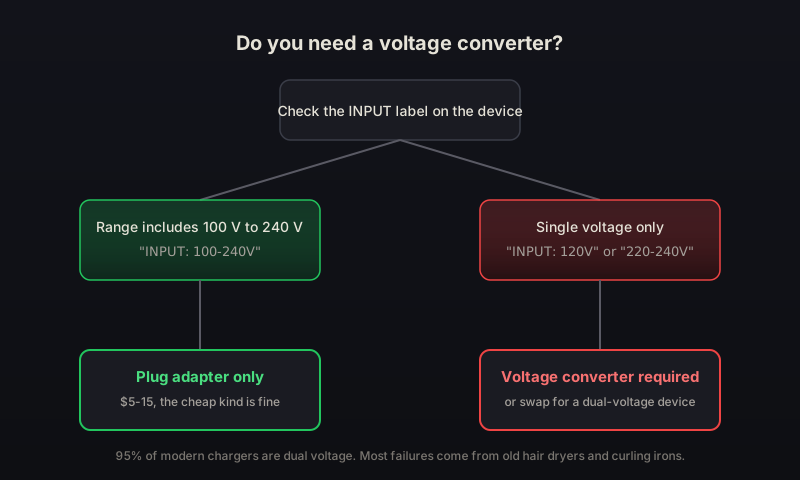
Flip your device over and find the INPUT line on the label. If it includes both 100 V (or below) and 240 V (or above), you don't need a converter. A plug adapter is enough.
If the INPUT line only mentions one voltage range (typically "120V" or "220-240V" alone), you either need a converter or a dual-voltage replacement.
Examples of dual-voltage labels:
INPUT: 100-240V ~ 50/60Hz 1.5A          → adapter only
INPUT: 110-240V ~ 50/60Hz 0.8A          → adapter only
INPUT: 100V-240V AC, 50/60Hz            → adapter only
Examples of single-voltage labels:
INPUT: 120V 60Hz 1500W                  → converter required
INPUT: 220-240V ~ 50Hz 2000W            → converter required
INPUT: 110V AC                          → converter required
Why dual voltage is so common
Switch-mode power supplies (the small electronic chargers used in almost every modern device) handle wide voltage ranges as a side effect of how they work. The same chip that converts AC to DC for your laptop can take any input from 100 V to 240 V without modification. Manufacturing single-voltage chargers would cost more in some cases.
This is why every laptop charger, phone charger, USB-C wall brick, camera battery charger, and almost every electric toothbrush sold globally is dual voltage. The only common holdouts are heating appliances (where the dual-voltage design adds significant cost) and some legacy consumer goods.
Choosing the right converter (if you need one)
If you've confirmed you need a converter, the rules for choosing one:
Rated wattage
The converter must be rated for at least the wattage of the appliance, ideally with a safety margin. A 1,500 W hair dryer needs a converter rated 2,000 W or more. Underspecified converters overheat and shut down (good case) or catch fire (bad case).
Step-up vs step-down
If you're going from low voltage (US, Canada, Mexico, Japan) to high voltage (UK, Europe, Australia, most of Asia), you need a step-up converter, but this is rare. The reverse, step-down, is more common.
Most converters sold for travel are step-down (high-voltage input, low-voltage output) because that's the more common direction for US travelers visiting Europe.
Continuous vs surge rating
Some converters advertise high "surge" wattage (e.g., "1,000 W continuous, 2,000 W surge"). The surge rating handles brief startup spikes from motors. For sustained loads like a hair dryer, only the continuous rating matters.
Build quality
Cheap converters are a fire hazard. If you must carry one, buy from a brand with safety certifications (UL, CE, ETL). Pay attention to the weight, transformer-based converters with real copper inside are heavier than electronic ones with capacitors and switching circuits. Both can work, but transformer-based converters are usually more reliable for heating appliances.
The case for buying local instead
For most appliances that would need a converter, the practical answer is to buy a dual-voltage or local-voltage version at your destination:
- Hair dryer: cheap travel models exist in every airport hotel duty-free for $20-40. Local hair dryers in Europe, Japan, and most countries cost less than a converter.
- Curling iron, straightener: same story. Buy a dual-voltage replacement before traveling, or buy local.
- Coffee maker, kettle, blender: never travel with these. They're sold everywhere for less than the cost of a converter.
The math on a $80 converter that weighs 2 kg vs a $30 dual-voltage replacement that weighs the same as the original is usually clear.
The combined adapter-converter trap
You'll see products advertised as "universal travel adapters with built-in voltage converter" for $30-50. The advertising suggests you can plug anything in anywhere and it will just work.
In practice these products are rated for very low wattage (typically 25-100 W) and provide unstable voltage. They're fine for charging a phone but useless for any appliance that actually needs voltage conversion. For phones, you don't need conversion at all because the charger is already dual voltage.
These devices solve a problem that doesn't really exist and create a false sense of security. Avoid them. Buy a quality adapter, check your devices for dual voltage, and carry a dedicated converter only if you've identified a specific need.
Quick decision rules
- Phone, laptop, USB-C device: adapter only
- Camera, e-reader, electric toothbrush, headphones: adapter only
- Hair dryer, curling iron, electric razor: check the label. If dual voltage, adapter only. If single voltage, buy local or converter.
- Kitchen appliances, kettles, blenders: don't travel with these
- Power tools and battery chargers: check the label
The bottom line
A travel adapter and a voltage converter solve different problems. Adapters change plug shape and almost everyone needs one. Converters change voltage and most travelers don't need one because modern chargers handle voltage conversion themselves.
The check is the INPUT line on every device label. If both 100 V and 240 V appear, you're set with just an adapter. If only one voltage is listed, you either need a converter or a dual-voltage replacement, the replacement is almost always the better answer.