If you're packing for Europe and worrying about whether your laptop will survive, here's the short answer: almost certainly yes. Modern laptop chargers are designed for worldwide use and handle 230 V European mains the same way they handle 120 V US mains. The only thing you need is a plug-shape adapter for the wall.
The two-second check that proves it: flip your charger over and look for the INPUT line on the label.
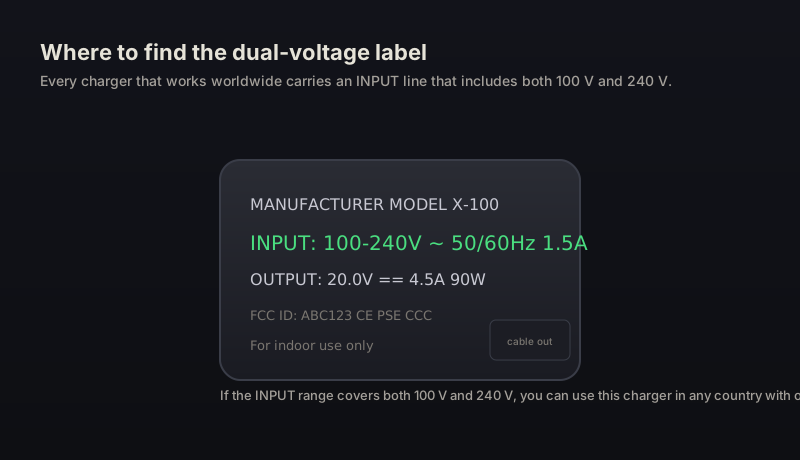
The dual-voltage check
Every charger that's safe to use worldwide carries a single specification on its label:
INPUT: 100-240V ~ 50/60Hz
The numbers that matter are the voltage range. If the low end is 100 V (or below) and the high end is 240 V (or above), the charger is dual voltage. That charger will work in:
- The US, Canada, Mexico (120 V)
- Japan (100 V)
- The UK, Europe, Australia, Asia (230 V)
- Anywhere in the 100-240 V range, which covers every major destination
The tilde symbol means alternating current; the 50/60Hz means it handles both grid frequencies. You don't need to think about either.
Why almost every modern laptop is dual voltage
Laptop chargers are switch-mode power supplies. The output is regulated by an electronic circuit that takes whatever AC voltage the wall provides and converts it to the stable DC voltage the laptop needs (usually somewhere between 19 V and 20 V for full-size laptops, 5 V to 20 V for USB-C laptops).
The chip that does this conversion costs cents and handles any input from 100 V to 240 V without modification. It would actually be more expensive to build a single-voltage charger today than a dual-voltage one. As a result, every major laptop manufacturer ships dual-voltage chargers globally:
- Apple (every MacBook charger since the original PowerBook G4 era)
- Dell, HP, Lenovo, Microsoft Surface, Asus, Acer
- All USB-C PD wall chargers from major brands
- All gaming-laptop chargers from Razer, MSI, Alienware
The exceptions are rare and mostly limited to:
- Some cheap aftermarket replacement chargers labeled for a single region
- A handful of legacy Windows laptop chargers from the early 2000s
- Some specialty business laptop chargers for the Japanese market
If your laptop charger is from this decade and from a major manufacturer, you're almost certainly fine.
How to handle the exception
If you flip your charger over and the INPUT line reads only "120V" or "110-127V" without a range, you have a single-voltage charger. Plugging it into European 230 V mains via a passive adapter will fry the charger within seconds.
Options in order of cost:
- Buy a replacement dual-voltage charger from your laptop's manufacturer or a quality third party. Cost: $30-80, available before you fly or at major airports. This is almost always the right answer.
- Buy a USB-C PD travel charger if your laptop accepts USB-C charging. Cost: $30-50. Works for almost any newer laptop, MacBook, Surface, Dell XPS, ThinkPad, etc.
- Carry a step-up voltage converter rated for your laptop's wattage. Cost: $40-80. Heavy, bulky, less reliable, and prone to overheating if you exceed its rating. Avoid unless you have no other option.
A USB-C PD travel charger is usually the best option even if your existing charger is fine, because it doubles as a phone charger and fast charger for any USB-C device.
What about voltage spikes and surges?
Modern laptop chargers handle nominal voltage variation (220-240 V in Europe, 100-127 V in the Americas) without issue. They also tolerate brief spikes thanks to internal surge protection.
The exception is sustained over-voltage from a faulty grid (rare in major European cities) or a lightning-induced spike (more common in summer storms). A small travel surge protector adds insurance for under $20 and is worth it if you're carrying anything expensive.
What about the plug shape?
The dual-voltage check handles the electrical side. You still need a physical adapter to convert your US plug to the wall socket shape:
- UK: Type G (three-rectangular-pin)
- France, Germany, Spain, Italy, Netherlands, most of Europe: Type C/E/F (round pin)
- Switzerland: Type J (its own unique design)
- Ireland, Malta, Cyprus: Type G (same as UK)
A simple US-to-Europe adapter ($5-10) handles most countries. A universal adapter ($15-30) covers everything including the UK, Switzerland, and Italy. See our country-specific guides for the right adapter per destination.
A worked example
Take a 2023 MacBook Air. The charger label reads:
Apple 30W USB-C Power Adapter
INPUT: 100-240V ~ 50/60Hz 0.75A
OUTPUT: 5V/3A, 9V/3A, 15V/2A, 20V/1.5A
The INPUT line shows 100-240V, so it's dual voltage. The same charger works in New York, London, Paris, Tokyo, Sydney, and Bangkok. The only difference is which plug adapter you use.
For a US-to-UK trip you need a Type G adapter (£5 at any travel store). For a US-to-France trip you need a Type C/E adapter (same price). The MacBook itself doesn't know or care.
Quick checklist before you fly
- Flip your charger over and find the INPUT line
- Confirm both 100 V (or lower) and 240 V (or higher) are in the range
- Buy the appropriate plug-shape adapter for your destination
- For older or aftermarket chargers, check carefully, swap if single-voltage
- Bring a small surge protector if traveling to areas with unstable grids
That's it. No converter, no special travel laptop, no expensive accessories. Modern laptops are engineered for travel out of the box.
The bottom line
Almost every laptop charger made in the last decade works in Europe with just a plug adapter. The two-second check is the INPUT line on the charger label, look for 100-240V.
If your charger is older, aftermarket, or labeled only 120 V, swap it for a dual-voltage replacement before you fly. A modern USB-C PD charger from Anker or Apple costs less than a steak dinner and pays for itself in peace of mind.
Confirm. Pack adapter. Travel.