Australia's plug is one of the most distinctive in the world, two flat pins angled into a V, with a third vertical pin below for earth. Outside of Oceania and a handful of countries that adopted the same design, you'll find this plug almost nowhere. Which means every visitor to Australia needs an adapter unless they're flying in from New Zealand, Fiji, or another Type I country.
The quick answer:
- From the US or Canada: Adapter required. Voltage check critical.
- From the UK: Adapter required. Voltage match is fine.
- From the EU (Schengen): Adapter required. Voltage match is fine.
- From New Zealand or Fiji: Nothing needed.
- From China or Argentina: Often nothing needed (similar Type I), but verify fit.
What plug does Australia use?
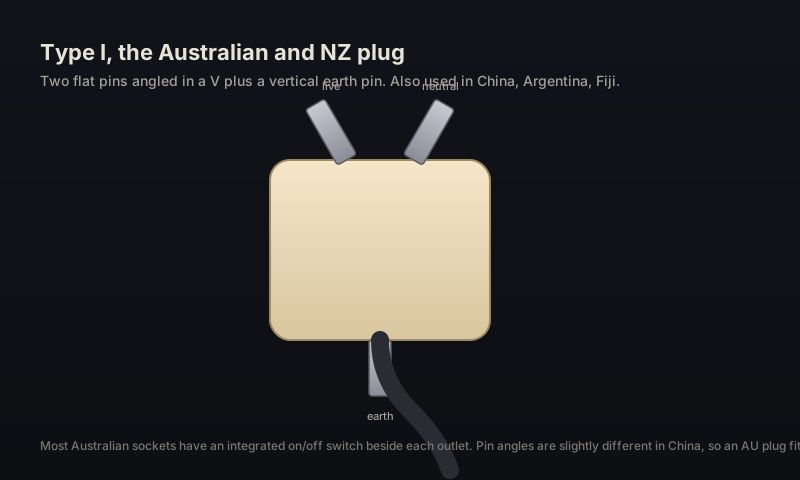
Australia and New Zealand share AS/NZS 3112, the standard that defines the Type I plug: two flat pins angled at 30 degrees from vertical forming a V, plus a vertical earth pin below. The same plug works in Fiji, Papua New Guinea, the Cook Islands, and parts of Argentina. China uses a near-identical Type I but with slightly different pin angles, which means an Australian plug usually fits a Chinese socket but not always the other way around.
Australian wall sockets have one practical quirk that confuses first-time visitors: every socket has a switch beside it. Plug your charger in, then flip the switch. If your laptop isn't charging, the switch is almost always the culprit, not your adapter or your charger.
Australia's voltage and frequency
Australia is officially 230 V, 50 Hz, harmonized with the EU and UK in 2000. In practice, most Australian outlets deliver 240 V, which is what the grid was originally built for. Any device rated 220-240 V or 100-240 V handles this fine.
For US and Canadian travelers, that's roughly double your home 120 V. Any modern phone or laptop charger is dual voltage and handles it without issue, but single-voltage US hair dryers, curling irons, and shavers will fail.
For UK, EU, and Asian travelers from 230 V countries, voltage matches and only the plug shape changes.
Do I need a travel adapter for Australia? By origin country
From the United States or Canada
Adapter required. None of your US plugs fit an Australian socket. The voltage difference is the bigger concern, your 120 V US mains becomes 240 V Australian mains.
Dual-voltage chargers (look for 100-240 V on the brick) are fine. Single-voltage US appliances will fail. Pack:
- A US-to-Australia adapter (or universal with Type I)
- Confirm every device says 100-240 V
- Leave 120 V-only hair dryers, curling irons, and shavers at home
From the United Kingdom or Ireland
Adapter required, voltage match is fine. UK Type G is physically incompatible with Australian Type I. The good news: UK 230 V matches Australian 240 V close enough that any device you'd use in the UK works fine in Australia. UK-to-AU adapters are sold at any UK travel retailer for £4-8.
From the EU (Schengen area)
Adapter required, voltage match is fine. Europlug, Schuko, Type E, and Type L all fail in Australian sockets. EU-to-AU adapters cover the gap. Voltage matches.
From China
Often nothing needed, but verify. Chinese Type I pins are angled slightly differently from Australian, so a Chinese plug may not seat properly in an Australian socket even though they look identical. An Australian plug usually fits a Chinese socket more reliably than the reverse. If you're traveling China to Australia, pack a small AU-to-AU pin straightener adapter or a universal as a safety net.
From New Zealand, Fiji, Papua New Guinea, Cook Islands
Nothing needed. Same Type I plug, same 230-240 V mains. Just pack your existing charger.
From Argentina
Often nothing needed, Argentina uses Type I with the same pin angles as Australia. The voltage is also 220 V in Argentina, close enough to Australian 240 V that all dual-voltage chargers work fine.
Choosing single-country vs universal
For an Australia-only trip, a single-country adapter is fine:
- $3-8 single-country AU adapter at any travel retailer
- Compact, fits in any laptop bag
- Pair with a UK origin? Buy UK-to-AU. Pair with US origin? US-to-AU.
For a multi-country trip including Australia (Australia + Bali + Singapore is a common circuit), a universal adapter saves space and time. Look for:
- Explicit Type I support, all good universals have this
- USB-C PD port at 30 W or higher
- 2-3 USB-A ports for older devices
- Surge protection, useful during Australian summer storms
The one mistake that fries devices
The Australia-specific failure mode: forgetting to switch the wall socket on. Travelers from countries without switched outlets (US, EU, many parts of Asia) will plug in, walk away, come back to a dead laptop. Always flip the switch.
The voltage failure mode is the same as for any 230 V destination. US 120 V appliance + adapter + Australian 240 V outlet = device dies. Check the back of every device for 100-240 V before you pack.
Practical answers for common Australian travel situations
Will my MacBook charger work in Australia? Yes. All Apple chargers are dual voltage. Add a US-to-AU or EU-to-AU adapter and you're set.
Do I need a converter for my hair dryer? If it's dual voltage (100-240 V), no. If it's single voltage at 120 V, yes (or just don't bring it, every Australian hotel has a wall-mounted dryer).
Can I buy an Australian plug adapter at Sydney or Melbourne airport? Yes, AUD $15-25 for the same adapters Kmart sells for $5-10 in the city. If you have time before checking in, the city store is significantly cheaper.
What about Bali and other Indonesian destinations? Indonesia mostly uses Type C and Type F (round pin European plugs), not Type I. If your trip goes Australia to Bali, plan for two different plug types or a universal.
Are Australian power outlets reliable? Yes, very. The grid is modern and well-maintained, with low fault rates. The one exception is cyclone-prone areas in the north (Queensland, Northern Territory) during the wet season, where temporary outages and surges happen. A surge protector is worth the few dollars.
Will my UK kettle work in Australia? Plug-fit no without an adapter, voltage yes. Most travel-sized kettles are dual voltage in any case.
Charging multiple devices at once
Australian sockets typically come in pairs (a double outlet faceplate) but each socket has its own switch. For travel charging, useful options:
- A GaN multi-port USB-C/USB-A charger with an AU plug, charges 4 devices off one socket
- A UK or US power strip plus an adapter, just remember to switch the wall socket on
- A USB-C hub charger that plugs directly into AU sockets, exposes 4-5 USB-C ports
Australian sockets deliver 10 A per outlet (2,400 W at 240 V), enough for any travel charging setup.
The bottom line
Australia needs a Type I adapter for every traveler who isn't already from an Oceania or Type I country. The plug is distinctive and a universal adapter from your home country may or may not support it cleanly, double-check Type I is on the spec sheet.
The two things to actually do:
- Buy or pack a Type I-compatible adapter
- Flip the switch on the wall outlet (this catches more visitors than anything else)
Voltage is the same as the UK and EU, so for those travelers nothing else matters. For US travelers, the dual-voltage check is the difference between working chargers and dead devices.