The United Kingdom is the country where plug standards became a deliberate design exercise rather than an accident of history. The Type G plug you'll be navigating is the largest in common use anywhere in the world, and there's a reason for every cubic centimeter of it: a built-in fuse, sleeved live pins, safety shutters, and an earth pin that's longer than the others on purpose.
Here's what to pack:
- From the US or Canada: Adapter required. Voltage check required.
- From the EU (Schengen): Adapter required. Voltage match is fine.
- From Australia or NZ: Adapter required. Voltage match is fine.
- From other Type G countries (Ireland, Singapore, Hong Kong, Malaysia, UAE): nothing needed.
What plug does the UK use?
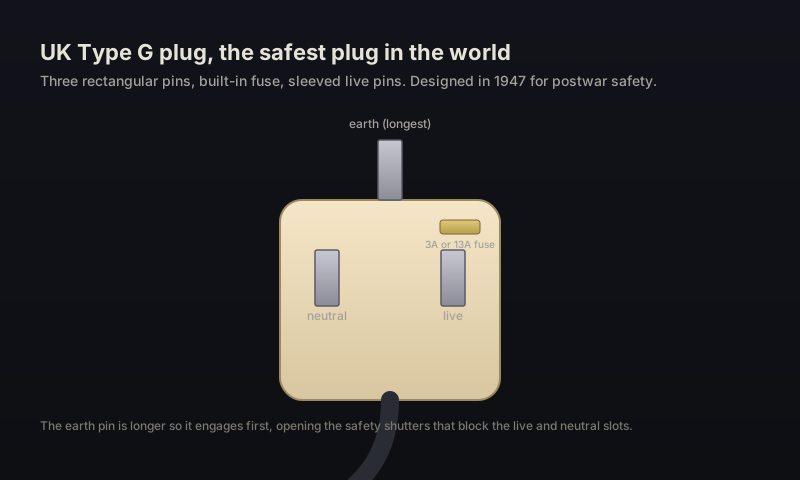
The UK uses Type G exclusively. Other plug types simply don't fit, and the country has had this single standard since the 1947 introduction of BS 1363, the British Standard that defines the modern Type G.
The Type G plug's defining features are all safety-driven:
- Three rectangular pins arranged in a triangle, with the longest pin at the top acting as the earth (ground)
- A built-in fuse in series with the live pin, replaceable when blown, typically rated 3 amps for low-draw devices and 13 amps for kettles and other heating appliances
- Sleeved live pins, the bottom half of the live and neutral pins is insulated so your fingers can't touch live metal while inserting or removing the plug
- A long earth pin that physically opens safety shutters in the socket before the live and neutral slots become accessible
UK sockets have switches next to every outlet. Most British homes still default to switching outlets off when not in use, a habit left over from the cost-conscious postwar era and reinforced by the design philosophy.
UK voltage and frequency
The UK runs on 230 V, 50 Hz, harmonized with the rest of Europe in 1995. In practice, UK outlets often read 240 V or a touch higher, because the underlying infrastructure was built to a 240 V specification. The 230 V harmonization adjusted the tolerance band rather than the actual delivered voltage. Any device rated 220-240 V (or 100-240 V) works fine.
For travelers from the US (120 V) and Canada (120 V), this is double your home voltage. The dual-voltage check matters. For travelers from the EU, Australia, NZ, Singapore, Hong Kong, and most of the world, the voltage already matches and you only need the plug-shape adapter.
Do I need a travel adapter for the UK? By origin country
From the United States or Canada
Adapter required. Your two-pin or three-pin US plug is physically incompatible with a UK Type G socket.
Voltage matters more here than the plug change. Your 120 V US mains becomes 230-240 V UK mains. Dual-voltage chargers (look for 100-240 V on the brick) handle this fine. Single-voltage US appliances will fail, sometimes dramatically. The common casualties:
- US hair dryers rated 120 V only
- US curling irons and straighteners
- US battery chargers for power tools
- Old desk lamps with non-LED bulbs
Buy a US-to-UK adapter that has a built-in earth pin (some cheap ones omit it, which prevents UK sockets from opening). Cost: $5-15 on Amazon, £5-10 at a UK airport.
From the EU (Schengen area)
Adapter required. Europlug, Schuko, Type E (French), and Type L (Italian) all fail the UK socket shape test. The good news: the voltage matches, 230 V to 230-240 V, so no converter needed.
A few options:
- A single-country EU-to-UK adapter, £3-5 at any UK supermarket or Boots
- A universal travel adapter that explicitly includes UK Type G
- A travel power strip with EU Schuko input and UK Type G outputs (useful if you're a family with multiple devices)
From Australia or New Zealand
Adapter required. Australian Type I doesn't fit UK Type G. Voltage matches at 230 V. AU-to-UK adapters are easy to find online or at airports in either direction.
From other Type G countries
You're already covered. Ireland, Singapore, Hong Kong, Malaysia, the UAE, Cyprus, Gibraltar, and Malta all use Type G with the same 230 V mains. Just pack your existing charger.
Choosing single-country vs universal
For a UK-only trip, a single-country adapter is sensible:
- $3-8 single-country UK adapter at any travel store
- Compact, foolproof, fits in any laptop bag pocket
- Look for one with the earth pin physically present (some cheap models omit it, and UK sockets won't open without it)
For a multi-country European trip, a universal adapter saves the hassle. Look for one that:
- Has explicit UK Type G coverage (most do)
- Includes a USB-C PD port rated 30 W or higher
- Has surge protection
- Is small enough to live in your laptop bag
Avoid universal adapters that use a fake plastic earth pin to defeat UK socket shutters. These are common in cheap multi-country adapters and they technically work but bypass the safety system the UK plug was designed around. They're also illegal to sell in the UK without certain markings, though they're still widely available online.
The one mistake that fries devices
Plugging a US 120 V appliance into a UK 230 V outlet via a passive adapter is the most common failure. The adapter changes the plug shape, not the voltage. A US hair dryer plugged into UK mains via an adapter draws nearly four times the power the device is designed to handle (power scales as the square of voltage), which is why it fails so spectacularly.
The defense is the label check. If your device says only "120 V" anywhere on the brick or housing, it needs either a step-up converter (heavy, awkward, expensive) or a swap for a dual-voltage equivalent.
Practical answers for common UK travel situations
Will my MacBook charger work in the UK? Yes. Every Apple charger is dual voltage. Add a US-to-UK adapter and you're done.
What's the difference between the 3A and 13A fuse in a UK plug? The 3A fuse is for low-draw devices like chargers, lamps, and small electronics. The 13A fuse is for kettles, hair dryers, and other heating appliances. If you ever need to replace a blown fuse in a UK plug, it's a 60-second job with a small screwdriver.
Do UK hotels provide adapters? Most do at reception, often free for short stays. Larger hotels in London (Marriott, Hilton, Premier Inn) almost always have spare adapters on hand. Boutique B&Bs and small inns less reliably so.
Can I buy a UK adapter at Heathrow or Gatwick? Yes, at airport markup: £10-15 for adapters that cost £3-5 in a Boots or Tesco. If you're connecting through London with a few spare minutes, the airport shop is the path of least resistance.
Will my US iPhone work in the UK? Yes. iPhones are dual voltage at the charger. The phone itself runs on the battery's internal 5 V regardless. Add a US-to-UK plug adapter and you're charging.
What about Scotland, Wales, and Northern Ireland? Identical: Type G socket, 230 V, 50 Hz, same fuses, same switches.
Can I use my UK plug in the Republic of Ireland? Yes. The Republic of Ireland uses the same Type G plug and 230 V mains. No adapter needed crossing the border.
Charging multiple devices at once
UK sockets often come in pairs (a single faceplate with two sockets) and are usually switched. For travel charging, a few useful options:
- A GaN multi-port charger with a UK plug, charges 4 devices off one socket
- A small UK-input travel power strip, useful in older B&Bs where one socket per room is common
- A USB-C hub charger that plugs straight into UK Type G
UK sockets typically deliver 13 A per outlet (3,000 W total at 230 V), so a single socket can easily handle a multi-device charging setup. Don't daisy-chain power strips, though, the fuse in the plug at the wall will blow.
The bottom line
The UK is a straightforward destination once you have one Type G adapter and the voltage check sorted. The plug is big but well-designed, the mains is consistent, and almost every accommodation can lend you an adapter if you forget.
Pack one adapter. Check that every charger says 100-240 V on the brick. Done.