France runs Type E sockets, which look like Schuko but use a male earth pin sticking out of the wall instead of side clips. A Europlug fits any French socket. A French plug fits in Germany or Italy but the earth pin gets in the way of some non-French sockets, so a French-to-Europe adapter is sometimes useful even within the EU.
Quick answer by origin:
- From the US or Canada: Adapter required. Voltage check required.
- From the UK: Adapter required. Voltage match is fine.
- From the EU (Schengen): Often nothing needed.
- From Australia or NZ: Adapter required. Voltage match is fine.
What plug does France use?
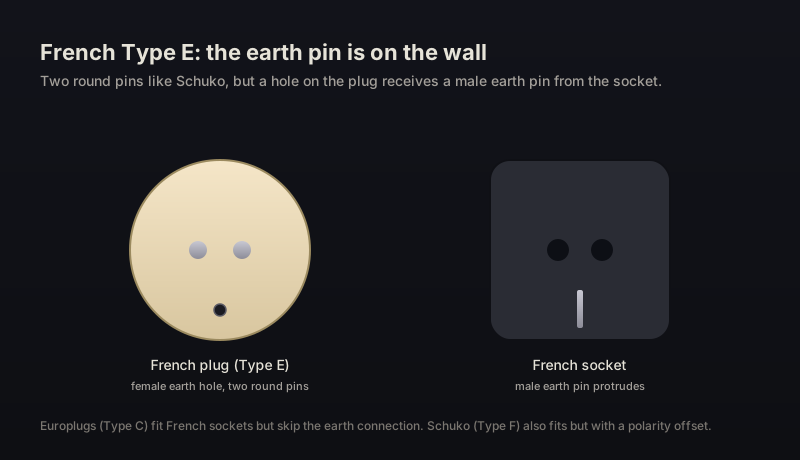
France uses Type E throughout the country, including overseas territories (French Guiana, Martinique, Guadeloupe, Reunion). The defining feature is the male earth pin in the wall socket: the plug has a small hole on the body that fits over a metal pin protruding from the socket, completing the ground connection when fully inserted.
In practical terms:
- Europlugs (Type C) fit French sockets but don't engage the earth pin. Fine for low-draw devices and chargers, less ideal for high-current appliances.
- Schuko (Type F) plugs fit French sockets via the round pins. The Schuko side clips don't contact anything in a French socket but the connection is still safe.
- French Type E plugs fit Schuko sockets in Germany, Spain, Italy, etc., though the earth pin sometimes prevents seating in tight socket placements.
France's voltage and frequency
France runs 230 V at 50 Hz, harmonized with the rest of Europe. The grid is operated by RTE and is among the most stable in Europe due to the country's heavy nuclear baseload.
For US and Canadian travelers, this is roughly double your 120 V home mains. Dual-voltage chargers handle the difference; single-voltage US appliances will fail.
For UK, EU, and other 230 V country travelers, voltage matches and only the plug shape changes.
Do I need a travel adapter for France? By origin country
From the United States or Canada
Adapter required. US plugs don't fit French sockets. Buy a US-to-Europe adapter (the cheap ones work, Type E and Schuko both accept Europlug-shaped pins, so a basic Europlug-style adapter handles France fine).
Voltage check: every device needs to be labeled 100-240 V on the brick. Single-voltage US hair dryers, curling irons, and shavers will fail.
From the United Kingdom or Ireland
Adapter required, voltage match is fine. UK Type G is physically incompatible with French sockets. Any UK-to-Europe adapter works. Voltage matches at 230 V.
From the EU (Schengen area)
Often nothing. Europlugs and Schuko plugs both fit French sockets. The exceptions are Italian Type L and UK Type G, both of which need an adapter.
A note for German travelers: your Schuko plugs fit French sockets without polarity guarantee. For most devices this is fine.
From Australia or New Zealand
Adapter required, voltage match is fine. Type I doesn't fit French sockets. AU-to-Europe adapters cover it.
Choosing single-country vs universal
For a France-only trip, any Europlug-style adapter works. Even cheap supermarket adapters labeled "Europe" usually handle France. Cost: $3-8 at any travel retailer.
For a multi-country EU trip, a universal adapter saves space. Look for one that:
- Has Europlug or Schuko coverage
- Includes USB-C PD at 30 W or higher
- Is compact (France-only travel often means city walking with a small bag)
The one mistake that fries devices
US travelers plugging a single-voltage 120 V appliance into French 230 V mains. The plug shape adapter doesn't change voltage. A US hair dryer plugged into a French socket via an adapter will burn out within seconds.
Check the brick on every device for 100-240 V before you pack. If the label says only 120 V, it stays home.
Practical answers for common French travel situations
Will my MacBook charger work in France? Yes. All Apple chargers are dual voltage. Add a US-to-Europe adapter and you're set.
What about the French overseas territories? Same Type E, same 230 V, same 50 Hz. Martinique, Guadeloupe, French Guiana, Reunion, Mayotte all on the same standard.
Are French hotels reliable for power? Yes. The French grid is among the most stable in Europe due to heavy nuclear baseload. Even small B&Bs in rural Provence or Brittany have modern Type E sockets.
Can I buy an adapter at Charles de Gaulle airport? Yes, at airport markup: €8-15 for the same adapters Monoprix sells for €2-4. Stop at a city store if you have time.
Will my UK three-pin shaver charge in France? Yes with a UK-to-Europe adapter. Voltage matches at 230 V.
Charging multiple devices at once
French outlets typically come singly per faceplate in older buildings, sometimes in pairs in new construction. For travel charging:
- A GaN multi-port charger with a Europlug or Schuko, charges 4 devices off one socket
- A Europlug-input travel power strip with 2-3 universal sockets
- A USB-C hub charger that plugs into Type E sockets
French sockets deliver 16 A per outlet (3,680 W at 230 V), more than enough.
The bottom line
France is straightforward once you have a Europlug-compatible adapter. The Type E socket's male earth pin is a curiosity, not a problem, your adapter doesn't need to do anything special to handle it.
One adapter, voltage check on every device, done.