India runs on a mix of plug standards inherited from British colonial-era electrical engineering: Type D and Type M for grounded sockets, with Type C Europlug accepted for low-draw devices because the round-pin spacing matches. New construction increasingly uses Schuko Type F, but you should plan for Type D unless you know otherwise.
Quick answer by origin:
- From the US or Canada: Adapter required. Voltage check critical.
- From the UK: Adapter required (UK Type G doesn't fit Type D). Voltage match is fine.
- From the EU (Schengen): Often nothing needed (Europlugs fit Type D sockets).
- From Australia or NZ: Adapter required. Voltage match is fine.
What plug does India use?
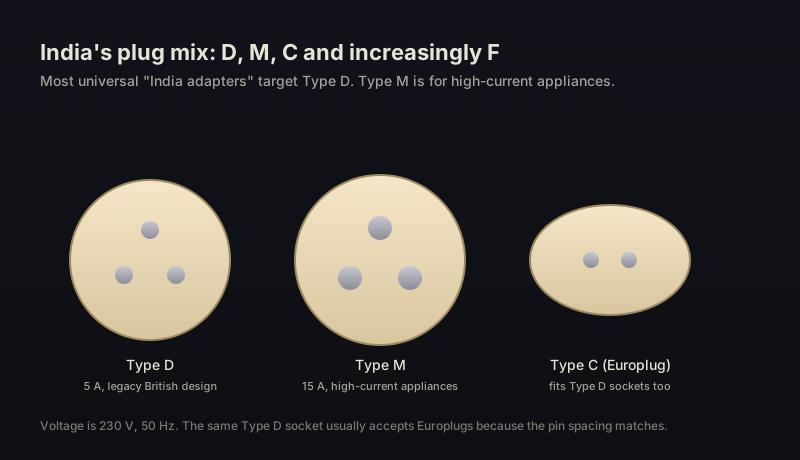
India's primary plug is Type D, a three-pin design with round pins arranged in a triangle. The plug was the British standard before 1947 and India kept using it after independence, while the UK moved to Type G. Type M is the same shape but with much thicker pins (7 mm vs 5 mm) for high-current appliances like air conditioners and water heaters.
In practice:
- Hotels and modern accommodations: Type D sockets with hybrid bezels that also accept Europlugs
- Older buildings: pure Type D, sometimes worn or loose
- New commercial construction: Type F Schuko sockets, accept Europlugs directly
- Dedicated high-current circuits: Type M sockets, only for appliances rated 15 A or higher
Most travel adapters labeled "India" target Type D sockets. A Europlug will also fit most Type D sockets because the pin spacing happens to match. Whether the earth connection works depends on the specific socket.
India's voltage and frequency
India runs at 230 V, 50 Hz. The grid is managed by the Power Grid Corporation of India and the state-level distribution companies. Voltage stability varies by region:
- Tier-1 cities (Mumbai, Delhi, Bangalore, Chennai, Kolkata, Hyderabad): usually within 5% of spec
- Tier-2 cities: 10% variation common, occasional load shedding
- Rural and tier-3 cities: significant voltage variation, regular planned outages
Most Indian homes and hotels above mid-range have voltage regulators ("stabilizers") inline with sensitive equipment. Travelers carrying laptops or expensive cameras should plug into a surge protector.
For US and Canadian travelers, this is roughly double your home 120 V mains. The dual-voltage check matters: any charger labeled 100-240 V is fine, anything labeled only 120 V will fail.
For UK, EU, and Australian travelers, voltage matches and only the plug shape changes.
Do I need a travel adapter for India? By origin country
From the United States or Canada
Adapter required. US plugs don't fit Indian sockets. Voltage difference is the bigger concern: 120 V to 230 V means single-voltage US appliances will fail.
Pack:
- A US-to-India (Type D) adapter, or a universal that explicitly covers Type D
- Voltage check on every device for 100-240 V
- Surge protector recommended for laptops or sensitive equipment
From the United Kingdom or Ireland
Adapter required. UK Type G is incompatible with Indian Type D. The voltage matches at 230 V, so once you have the adapter, everything works as in the UK.
Look for a UK-to-India adapter that explicitly says Type D. Some generic "India" adapters only cover Type F or Type C, which are increasingly common but not universal yet.
From the EU (Schengen area)
Often nothing needed. Europlugs (Type C) fit Indian Type D sockets directly because the pin spacing matches. Schuko (Type F) plugs fit modern hybrid Indian sockets but not pure Type D.
If you're staying in older accommodations or smaller cities, pack a Schuko-to-Type-D adapter as a safety net for €3-5.
From Australia or New Zealand
Adapter required, voltage match is fine. AU Type I doesn't fit anything in India. AU-to-India or AU-to-universal-Europe adapters cover the gap.
Choosing single-country vs universal
For an India-only trip, a single-country adapter targeting Type D is sensible. Avoid the cheapest "world" adapters that don't explicitly cover Type D, the pin size is unusual enough that not all universals support it cleanly.
For a multi-country South Asia trip (India + Sri Lanka + Nepal + Bangladesh), a good universal adapter covers Type D, C, and F. All four countries use overlapping plug standards.
What to look for in an India-capable universal:
- Explicit Type D coverage (5 mm round pins in a triangle)
- USB-C PD at 30 W or higher
- Surge protection (Indian mains can spike during monsoon storms)
- Sturdy construction, Indian sockets can be worn from heavy use
The voltage caution for 120 V travelers
US travelers plugging single-voltage 120 V appliances into Indian 230 V mains via a passive adapter is the most common destructive failure. The adapter only changes the plug shape. Double the voltage, roughly quadruple the power, and the device burns out.
Defense: read the back of every device. If it doesn't say 100-240 V, treat it like it won't survive India.
Practical answers for common Indian travel situations
Will my MacBook charger work in India? Yes. All Apple chargers are dual voltage. Add a US-to-Type-D adapter or use a universal.
Are Indian hotels reliable for power? Variable. Premium hotels (Taj, Oberoi, ITC) have stable in-house power including diesel backup. Mid-range hotels usually have inverters that kick in during outages. Budget guesthouses and homestays may have 1-2 hours of load shedding per day in summer.
Can I buy an adapter in India? Yes, much cheaper than buying abroad. Any electronics shop or even most small general stores stock Type D adapters for ₹50-150 ($1-2). The Mumbai and Delhi airports also have shops at airport markup (₹500-1000).
Will my UK hair dryer work in India? Plug-fit no without an adapter. Voltage match yes (230 V to 230 V). Once you have the adapter, your hair dryer works at home power.
What about Indian states with different voltages? There's no state-level voltage variation in India. All states use 230 V at 50 Hz. The variation is grid stability, not specification.
Do Indian sockets have on/off switches? Yes, almost universally. Indian wall sockets come with a switch like UK sockets. Flip it on after plugging in.
Charging multiple devices at once
Indian outlets usually come singly per faceplate in older homes, in pairs in modern hotels. For travel charging:
- A GaN multi-port USB-C/USB-A charger with a Europlug, fits Indian Type D sockets directly, charges 4 devices
- A small Type C-input travel power strip with 2-3 universal sockets
- A USB-C hub charger that plugs into Type D
Indian sockets typically deliver 5 A for Type D (1,150 W at 230 V), enough for any modern charging setup. Avoid plugging high-draw appliances (kettles, irons) into Type D sockets, those need Type M circuits.
The bottom line
India needs a Type D adapter for almost every visitor. If you're flying in from the EU, your Europlug may fit Type D sockets directly, in which case you're set. For everyone else, buy a Type D-capable adapter before you fly or in any electronics shop after you arrive (where it's far cheaper).
Add a surge protector if you're carrying anything expensive. Confirm dual voltage on every charger. Plug in, flip the switch, charge.