Thailand makes travel adapters confusing for one reason: a Thai hotel socket usually accepts your plug whether you bring a US Type A, a European Europlug, or a Thai Type O. Most modern sockets are hybrid. The country also runs at 230 V, which is the same as Europe, the UK, Australia, and most of Asia, but different from the US, Canada, and Japan.
The quick answer:
- From the US or Canada: Probably no adapter needed for the plug, but you absolutely need to check device voltage.
- From the UK: Adapter required. Voltage match is fine.
- From the EU: Often no adapter needed (Europlug fits). Voltage match is fine.
- From Australia or NZ: Adapter required. Voltage match is fine.
What plug does Thailand use?
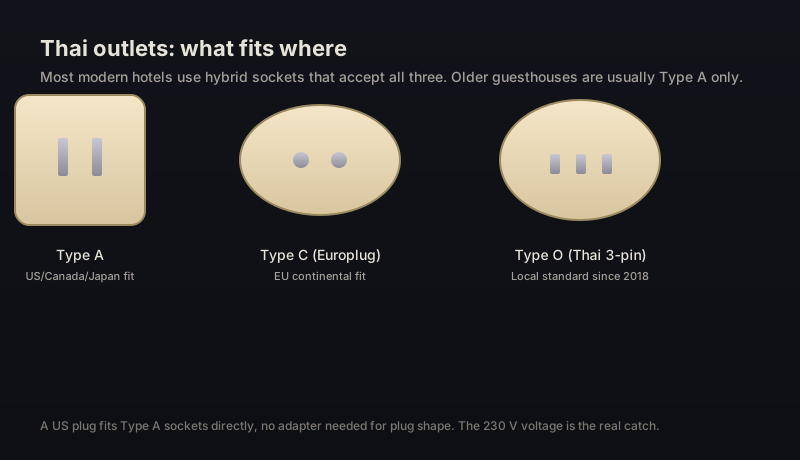
Thailand standardized on Type A for decades, with Type C (Europlug) accepted as a near-universal courtesy because most sockets accept its round pins through the same slots as Type A's flat pins. In 2018 the Thai Industrial Standards Institute formalized Type O, a three-pin grounded standard that's now showing up in new commercial construction, modern hotels, and high-end residential builds.
What you actually meet in the wild:
- Older guesthouses and family-run accommodations: ungrounded Type A only
- Three- and four-star hotels: hybrid sockets that accept Type A, C, and often Type O too
- Five-star resorts and new developments since 2020: dedicated Type O sockets, sometimes alongside hybrid sockets
- Anywhere with universal multi-socket plates: takes anything, including UK Type G and Australian Type I
If your accommodation is unspecified, plan for Type A. Anything that fits Type A also fits the hybrid sockets, so you can't go wrong.
Thailand's voltage and frequency
Thailand is 230 V, 50 Hz. The voltage spec matches the rest of harmonized Asia-Europe, but in practice you may see outlet readings anywhere from 215 V to 240 V depending on building age, region, and time of day. Bangkok and Chiang Mai are usually closer to spec; rural northern and southern provinces can be more variable.
For everything with a switching power supply (laptops, phones, tablets, cameras, headphones, e-readers), this voltage variance is invisible. The 100-240 V rating on the brick swallows the difference.
For anything with a heating element rated single-voltage, it matters a lot. See our voltage explainer for the full breakdown.
Do I need a travel adapter for Thailand? By origin country
From the United States or Canada
Plug-fit: usually no, your Type A flat pins fit Thai Type A sockets directly. Type B (three-prong grounded) may or may not fit depending on the socket age and whether the hotel has hybrid sockets.
Voltage: critical. Your 120 V US mains becomes 230 V Thai mains, which is almost double. Dual-voltage chargers (anything labeled 100-240 V) handle this without thinking. Single-voltage US appliances will fail, often dramatically. Common casualties:
- US hair dryers labeled 120 V only
- US curling irons and straighteners labeled 120 V only
- US battery chargers for power tools rated single-voltage
- Some older shaving and grooming gear
If you absolutely need a hair dryer in Thailand, buy a cheap travel one labeled 100-240 V before you fly, or use the hotel's. Almost every Thai hotel above budget grade has a wall-mounted hair dryer in the bathroom.
From the United Kingdom or Ireland
Adapter required. UK Type G plugs are physically incompatible with every Thai socket type. Buy a UK-to-Thailand adapter or a universal that explicitly covers Type O. Voltage match is fine, 230 V to 230 V, so anything you'd pack for use in the UK works in Thailand the same way.
From the EU (Schengen area)
Often nothing. Your Europlug (Type C) drops into Thai hybrid sockets directly, and most Schuko sockets in resorts will accept Type F (Schuko) as well. For older Thai Type A only sockets, a small Europlug-to-Type A adapter handles it for under $3. Voltage match is exact: 230 V to 230 V.
From Australia or New Zealand
Adapter required. Australian Type I plugs don't fit anything in Thailand. Any Type I to Type A or universal adapter works. Voltage match is fine.
From Singapore, Hong Kong, Malaysia (Type G origin)
Same as UK above: adapter required, voltage match is fine. UK Type G to Thai Type A adapters are cheap and widely sold in Bangkok airports.
Choosing single-country vs universal
For a Thailand-only trip, a single-country adapter is overkill. A US-to-Europe adapter or a universal you already own will likely work. If you don't have anything, the cheapest workable option is a Europlug-to-Type-A adapter from any travel store ($3-5).
For SE Asia trips spanning multiple countries (Thailand + Vietnam + Cambodia + Laos is a common circuit), get a universal adapter that covers Type A, C, F, G, and O. Look for:
- USB-C PD port at 30 W or higher (laptops, fast phone charging)
- 2-3 USB-A ports for older devices
- Surge protection (Thai mains has occasional spikes, especially during the rainy season)
- Compact form factor, the SE Asia trip usually involves frequent packing and unpacking
The one mistake that fries devices
The classic Thailand story: a US traveler arrives with a 120 V hair dryer, sees the plug fits, plugs it in. The dryer immediately makes a popping noise and starts smoking. The plug shape was right but the voltage doubled, and the heating element couldn't handle it.
Thailand is particularly dangerous for this mistake because US plugs physically fit, so the visual confirmation of "the plug works" lulls travelers into not checking voltage. Always check the back of the device. If it doesn't say 100-240 V, treat it like it won't survive.
Practical answers for common Thailand travel situations
Will my MacBook charger work in Thailand? Yes. All Apple chargers are dual voltage. Plug into any Thai socket with no adapter (if your charger is US) or a Type A adapter (if it's UK/EU/AU).
Are Thai sockets reliable? Generally yes in major cities, especially in hotels rated 3-star and up. Rural and budget accommodations are less consistent. If you're charging anything expensive overnight, a small surge protector is cheap insurance.
What about Bangkok's BTS Skytrain and airports? All major Thai transit hubs have public USB charging stations. Suvarnabhumi (BKK) airport, Don Mueang (DMK), Chiang Mai (CNX), and Phuket (HKT) all have USB-A and USB-C ports at gates and lounges.
Do Thai hotels provide adapters? Most do at the front desk on request, but stock is limited and often dirty or partially broken. Bring your own.
Can I buy an adapter at BKK or DMK on arrival? Yes, but at airport markup. ฿250-500 ($7-15) for adapters that cost ฿60-100 in any 7-Eleven or Thai electronics shop. The savings are real if you arrive early enough to pop out before checking in.
Will my UK three-pin shaver charge in Thailand? Yes with a UK-to-Type-A or universal adapter. The voltage matches at 230 V. Most modern electric shavers from Braun, Philips, and Panasonic are dual voltage anyway.
Charging multiple devices at once
Thai outlets are usually mounted at a single point per wall, often inconveniently placed near the floor in older buildings. A travel power strip pays for itself in convenience even if you only need it for one socket. Options that work well in Thailand:
- A GaN multi-port charger with a Type A plug, fits directly into Thai sockets, charges four devices from one outlet
- A Type A travel power strip with 2-3 grounded universal sockets on the output
- A USB-C hub adapter that converts one socket to four USB-C ports
For longer stays in beach or jungle accommodations where outlets are scarce, consider a battery-style charging station: a 20,000+ mAh power bank with multiple ports. Plug it into the wall once a day, charge devices off it the rest of the time.
The bottom line
For most travelers, Thailand is one of the easier countries on the planet for plug compatibility. Type A sockets accept US plugs directly, hybrid sockets accept almost anything, and the country is on the same 230 V standard as most of the world.
The two things to actually pack:
- A single travel adapter (skip if you're US/Canada and have only dual-voltage chargers)
- A clear understanding of which of your devices are dual voltage and which aren't
Pad your kit with a small surge protector if you're carrying anything expensive. Buy a Thai SIM at the airport. Enjoy the mango sticky rice.